 My title for this post is taken, of course, from the book by Rebecca Wells, who also gave us Divine Secrets of the YaYa Sisterhood. Her writing is so honest and sometimes so painful to read. What I love most is not necessarily the nature of the relationships between the women in her books, but simply that they have a deep, abiding relationship. I know that I am fortunate to have had several dear friends and a handful of sister-friends. What I am trying to pay attention to now is how to build new friendships with the women who may be the next YaYas in my life. As those friendships are slowly constructed, I find that I spend quite a bit of my time with my own "Little Altars." I have them all over my personal space: a trinket, a photo, a collection of objects - so many things help me keep the physical and the spiritual worlds connected.
Growing up, I learned to associate the word "altar" with terror and death. An altar was some horrible construction of rocks that was prepared for a bloody sacrifice in Old Testament stories, stories told to children as part of our Christian education. Sheep, primarily, but also calves and birds were ritually killed to appease a god that my child's heart rejected and wanted no part of. I vividly remember the picture in the Sunday School lesson book depicting the worst of these stories, the one about Abraham's willingness to sacrifice his son, Isaac. The picture, big and in full color, shows a teenage Isaac, nearly naked and hands bound behind his back, being pulled by his hair, belly up, onto a stone altar. Abraham, in flowing robes and long gray beard and hair, has a raised knife over his son, ready to plunge it into the innocent boy in obedience to God. Behind his upraised hand is an angel, reaching out to stop the awful act. Turns out the God didn't really want the sacrifice, only the willingness to make it. That's how it was explained to me anyway, but I never did buy it. This may have been one of my earliest clues that adults didn't always know what they were talking about.
I've since reclaimed the word "altar," taking it away from the themes of violence and domination and giving it over to the themes of connection, remembrance and embracing love. Sometimes they are deliberately constructed, sometimes they are recognized as altars after they have been in place a while. Sometimes they are elaborate, and sometimes so simple that only one or two people would recognize them as altars.
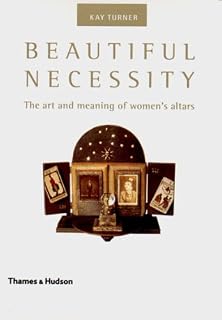 This book, Beautiful Necessity: The Art and Meaning of Women's Altars by Kay Turner is a 'must read' for any woman who recognizes that among the items she places in her home, either by design or unconsciously, are many altars. A friend loaned this book to me several years ago and it opened my eyes to what I was doing with my collections of doodads and chotchkes. They were altars! After this revelation the altar building began consciously, and has become something that is an important part of my spiritual life.
Here are some of the altars that I see every day, and really don't want to be without.
This one is for the grandbabies. It began with the nest and bird when my daughter was pregnant with Asaka. There is the dried husk of a sunflower, the first of the season, that bloomed on the day he was born, a tiger-eye stone (he was born under the sign of the Chinese Tiger), an amethyst which was a prayer stone during Kiyoko's gestation, and a small carved dragon charm, because she was born under the sign of the Dragon. The glass piece in the background was purchased in Vermont when our daughter graduated from Vermont Law. To me it looks like fiery, fluid spirit - just the thing to watch over these precious children.
There are many more altars in my home, and even more that are ephemeral. The blooming dogwoods, the mating song of the Carolina Wren, the early evening lightening and thunder. All keep me mindful of the largeness of life, the unavoidability of suffering, the necessity of beauty, the oneness of who we are and who we will become. Little altars everywhere.

